Getting started
Before going further, please make sure that you have installed PyRCN as recommended in the installation guide in a new virtual environment. Afterwards, you can continue with this getting started guide.
PyRCN is an open-source project which aims to provide a framework for developing Reservoir Computing Networks (RCNs) easily and transparently.
To learn more about the theoretical aspects of reservoir computing, you can read the page whats rc.
We also recommend you to have a look at the introduction page of ReservoirPy, which is another great resource, in particular for Echo State Networks.
Playing with blocks – Building blocks of Reservoir Computing
In the recent years, several groups have built toolboxes for Reservoir Computing. However, they were mostly able to implement one specific type of RCNs from - Echo State Networks - Extreme Learning Machines - Liquid State Machines
Problem is that, despite the similarities of different RCN architectures, nobody has decomposed RCNs in building blocks. Together with PyRCN, we aim to do that and provide building blocks with which almost any RCN structure can be composed.
Building your first Reservoir Computing Network
Essentially, with only one command, an Echo State Network can be defined using the
pyrcn.echo_state_network.ESNRegressororpyrcn.echo_state_network.ESNClassifierclass:>>> from pyrcn.echo_state_network import ESNRegressor, ESNClassifier >>> esn = ESNRegressor() >>> esn ESNRegressor(input_to_node=InputToNode(), node_to_node=NodeToNode(), regressor=IncrementalRegression())As we can see, the
esnconsists of different building blocks, e.g.pyrcn.base.blocks.InputToNode,pyrcn.base.blocks .NodeToNodeandpyrcn.linear_model.IncrementalRegression.The first block is used to connect the input features to the hidden neurons, the second building block defines how the connections inside the hidden neurons are organized. By default, all connections are randomly initialized and fixed.
In case one would like to customize the building blocks, you can have a look at the included modules of :py:module:
pyrcn.base.blocks.>>> import pyrcn.base.blocks as blocks >>> from inspect import getmembers, isclass >>> getmembers(blocks, isclass) [('BatchIntrinsicPlasticity', <class 'pyrcn.base.blocks._input_to_node.BatchIntrinsicPlasticity'>), ('HebbianNodeToNode', <class 'pyrcn.base.blocks._node_to_node.HebbianNodeToNode'>), ('InputToNode', <class 'pyrcn.base.blocks._input_to_node.InputToNode'>), ('NodeToNode', <class 'pyrcn.base.blocks._node_to_node.NodeToNode'>), ('PredefinedWeightsInputToNode', <class 'pyrcn.base.blocks._input_to_node.PredefinedWeightsInputToNode'>), ('PredefinedWeightsNodeToNode', <class 'pyrcn.base.blocks._node_to_node.PredefinedWeightsNodeToNode'>)]Obviously, there are a lot of derived modules from the basic building blocks available. Look their functions up in the documentation or in examples!
Training a RCN
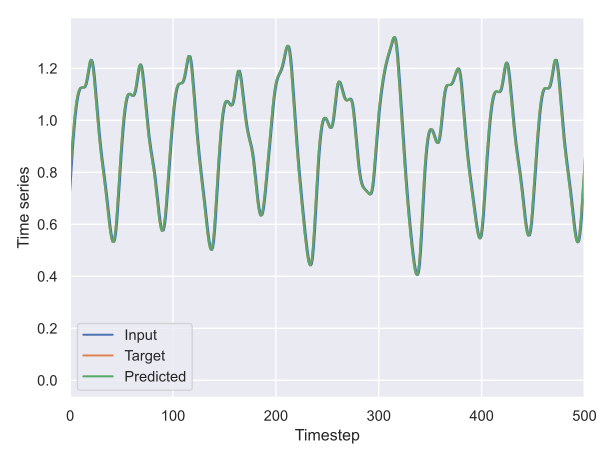
RCNs can be trained on different kinds of data. In particular, ESNs can then be trained on sequential data, such as timeseries, especially chaotic ones. In PyRCN, we have re-implemented the Mackey-Glass time-series from ReservoirPy, which is a common demonstration for ESNs:
>>> from pyrcn.datasets import mackey_glass
>>> X, y = mackey_glass(n_timesteps=8000)
If we visualize the Mackey-Glass time-series, we can see that it is a quasi-periodic time-series. We now use an :py:class:
pyrcn.echo_state_network.ESNRegressorto do a one-step ahead prediction of this time-series.To train the ESN, only three steps are required:
Randomly distribute the time-series to each reservoir neuron (Input-to-Node).
2. Compute the state of each neuron based on the current input and the previous state. 2. Compute a linear regression between the reservoir states and the target output.
These steps are handled via
pyrcn.echo_state_network.ESNRegressor.fit(), which is the most important function to train the ESN model:>>> # Fit the ESN model >>> esn.fit(X[:4000].reshape(-1, 1), y[:4000]) ESNRegressor(input_to_node=InputToNode(), node_to_node=NodeToNode(), regressor=IncrementalRegression(), requires_sequence=False)You can see that the ESN can be fitted using only one command. Afterwards, it is ready to use!
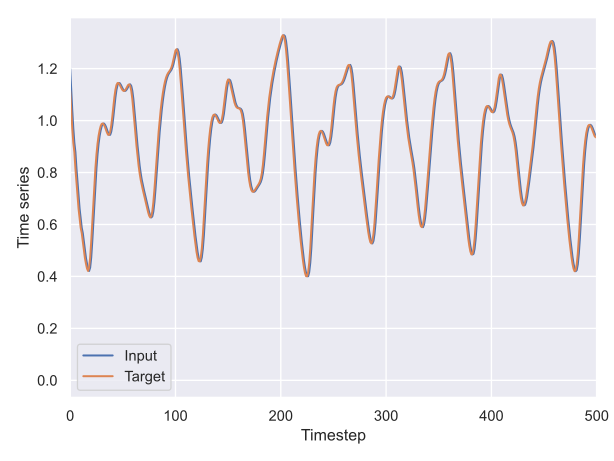
Testing and predict using the ESN
Finally, we use the
pyrcn.echo_state_network.ESNRegressor.predict()function to use the trained ESN to predict the test data:>>> y_pred = esn.predict(X[:4000])